
Johanna Drucker focuses her argument on the ways that the often overlooked graphic components of a text guide a reader through the work and influence narrative meaning. For Drucker, “the term graphic includes all aspects of layout and composition by which elements are organized on a surface” (121). Drucker adds that “navigation, the other term in play here, refers to the active manipulation of features on the level of discourse and presentation” (121). She argues that these “play an active role in all instances of textual representation, not only those in which images or pictorial elements are present” (121). These non-linguistic components can have a major impact on both visual and print narrative. Drucker’s stated goal is “to demonstrate that these graphic devices can be read as an integral part of narrative texts” (121), partially because showing the way that the graphic devices work, as well as exploring their limitations, “will tend to shift my argument towards a transactional, reader-based production of narrative and away from a more strictly structuralist or formal analysis of story texts” (122). Drucker wants to examine the visual element of narrative texts because “these navigational elements are historically and culturally specific, and thus learning to read them provides another way to understand the foundational assumptions and ideological values that form and inform a text” (122). Far from being merely accidental or the only way to organize text, he visual features that are often taken for granted can reveal much about the cultural/historical/ideological assumptions they embody.
Drucker also makes distinctions between graphic devices and navigation. She explains that “graphic devices are elements of layout and composition that organize and structure the presentation of narrative elements—in that sense they appear to be elements of discourse” (123). These devices don’t necessarily need to be illustrations or pictures. The basic organization of text and organizational markers qualify as graphic components. According to Drucker, “the graphic devices include headers, page numbers, spacing, and margins in print materials; framing and diagrammatic elements in print and electronic media; and any other visual element that serves a navigational purpose” (123). These elements enable a reader to navigate the text. Drucker ties this navigation to narrative meaning. She notes that these “devices provide the means for moving through or manipulating the sequence of the elements that constitute the narrative” (123). By facilitating the reader’s organization/recognition/understanding of the narrative, the graphic devices can have a serious impact on the meaning of that narrative. The organizational features of the text influence its meaning. The navigational and the graphic by features are connected because they “are all graphic. They are elements that often pass unnoticed, rendered invisible by their familiarity or by the inconsequential role they are usually assigned” (123). Noticing the graphic nature of these organizational markers and admitting to the importance of the graphic features of a narrative is important to Drucker, because “calling these features back into visibility is preliminary to addressing the way they engineer narrative experience and encode ideological values” (123). This understanding is vital, because once we see the graphic and navigational devices for what they are, “we start to see [them] as conventions, historically shaped, culturally specific, value-laden, and assumption-driven” (136). An understanding of what these features are and how they work could foster an understanding of the effects they produce and the reasons behind their use.
But Drucker doesn’t stop there. “My argument is not just for recognition of the semantic role played by graphic devices as integral to narration,” she summarizes, “that is foundational” (138). Drucker’s main aim is “to show that within the larger task of interpretation …we can read ideological, cultural, and historical matters in these graphic dimensions and the way they structure subject positions from which telling unfolds and within narrative is constrained and structured. I would go farther and say that certain assumptions, values, and beliefs can only be accessed through critical reading of these devices (138, italics mine). An understanding of how the visual arrangement/visual elements influence narrative meaning could provide a fuller understanding of the text, and the narrative presented within. For Drucker, an examination of these graphic and navigational devices is the key to understanding the cultural, historical, and ideological values hidden beneath the surface.
Considering the way the graphic/navigational elements function can also help us understand how we’ve been trained as readers. Reading a book, we read the pages sequentially, left-to-right/top-to-bottom. Chapter headings, the author’s name, the running title header, and page numbers are obviously meant to be skipped at the top/bottom of each page. As writers familiar with MLA formatting, we know that reading “last name page number” at the top of every page isn’t vital. We’re guided away from reading the external content (blogroll, links, advertisements, etc) when reading the entries/content of blogs, twitter feeds, and various other social media platforms. We’re kept aware of the reverse chronology. Drucker provides examples of graphic devices existing simultaneously as navigational features and narrative content. She shows them at work in flow charts, web content, Chris Ware comics, and “The Golden Circlet”, as well as simulations like Second Life and Flight Simulator.
Drucker also outlines the graphic/navigational characteristics of comics. Even when the boxes are outside the standard rectangular form, it still contributes to the navigational element of the story. Swamp Thing is one example. When the Swamp Thing character is the main focus/perspective, the panels are twisted and branchlike. When the comic presents the perspective of an orderly character, they are rectangular, and when they focus on a character dealing with The Rot (evil), the panels are clouded and malignant looking. The panels emphasize the perspective given to the action within the comic. Here, the organization and graphic presentation reinforce the narrative content.
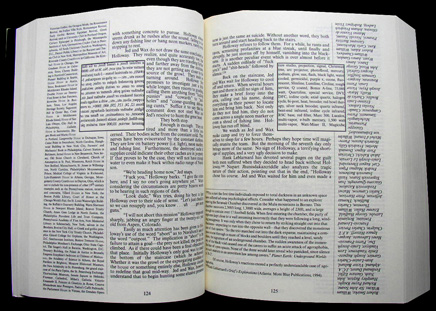
Another text that employs these navigational features as a part of its content is Mark Z. Danielewski’s House of Leaves. The story is created through a series of fictional pasted together articles and has no fewer than 3 narrators (The original compiler, the one who found it, and the publishing editor). The content of the book constantly refers back to its own fiction appendix or works which don't appear in the book that either can be found, and have little to do with the novel, or are completely fictionalized. This makes that navigational element of the novel very apparent. You do not read that book cover to cover; instead, it is read in parts as the reader is forced to navigate through the different narrators, subplots, and completely missing information. In a work like this, not only do the graphic navigational devices make themselves clear to the reader, the entire basis of the narrative depends on how the reader navigates the work. This renders the navigational and graphic elements visible, while also requiring an understanding of the use of the navigational/graphic to understand the narrative.



No comments:
Post a Comment