Sunday, November 20, 2011

It's just SO Media!


I’m about halfway through Super Sad True Love Story, and I think there are a lot of interesting things going on in this “bound, printed, nonstreaming Media artifact” (90).  I really like the way Shteyngart changes POV/Form.  By switching between Lenny’s diary and Eunice’s globalteens emails/instant message conversations, Shteyngart offers both characters’ perspectives on the events that unfold.  Instead of moving along from event to event with a single perspective, we’re given Lenny’s painfully optimistic take on the story, which is followed/undercut by Eunice’s conversations with friends and family.  Getting both perspectives shows what these particular events mean to each character, reveals a lot about each character, and explains the current political/economic situation through their observations and reactions.

There are some interesting moments where technology and media are addressed as well.  Having Lenny maintain a dated appreciation for books is one way to set him against the technological society he inhabits.  Upon returning to his apartment, Lenny talks to his “Wall of Books” (52), telling them “you’re my sacred ones …no one but me still cares about you.  But I’m going to keep you with me forever.  And one day I’ll make you important again” (52).  This says volumes (heh!) about Lenny’s unique appreciation for the printed word.  This really isn’t very far from the borderline-irrelevant status of books today.  When Lenny speaks with his boss, this love for books is described as a problem.  Joshie tells Lenny that “those thoughts, these books, they are the problem …you have to stop thinking and start selling.  That’s why all those young whizzes in the Eternity Lounge want to shove a carb-filled macaroon up your ass …you remind them of death.  You remind them of a different, earlier version of our species” (66-7).  In spite of his expressed desire for immortality, Lenny’s early allegiance to books pegs him as mortal and obsolete.  Lenny lets the desire for immortality win out, and starts to distance himself from his books.  Later on, he writes in his diary.  In one entry, he notes that “I’ve spent an entire week without reading any books or talking about them too loudly.  I’m learning to worship my new äppärät’s screen, the colorful pulsating mosaic of it, the fact that it knows every last stinking detail about the world, whereas my books only know the minds of their authors” (78).  By accepting the limitations of the book, and embracing the newer media form, Lenny appears to be taking the right steps toward the indefinite extension of his life.  I like the treatment of the whole “if you have enough money you don’t have to die” angle of this story.  This desire to attain immortality sounds almost pathological.  Considering the things Lenny has to give up to chase this dream made me think about extension of life in the classic/cliché “quality over quantity” terms.

Since I started the blog for this class with a reference to a musical act/reference I felt would be appropriate, I’ll end my last post with some more music. It would be a nice bookend (hah!) for the posts.  As tangential as it may seem, I kept thinking about a few songs whenever Lenny would talk about immortality.  The band Listener describes themselves as “Talk Music” (think a blend of alt-country and spoken word poetry). The songs “I don’t want to live forever” and “you have never lived because you have never died” just seem appropriate, so:


Sunday, November 13, 2011

Johanna Drucker Expertise

Johanna Drucker focuses her argument on the ways that the often overlooked graphic components of a text guide a reader through the work and influence narrative meaning.  For Drucker, “the term graphic includes all aspects of layout and composition by which elements are organized on a surface” (121).  Drucker adds that “navigation, the other term in play here, refers to the active manipulation of features on the level of discourse and presentation” (121).  She argues that these “play an active role in all instances of textual representation, not only those in which images or pictorial elements are present” (121).  These non-linguistic components can have a major impact on both visual and print narrative.  Drucker’s stated goal is “to demonstrate that these graphic devices can be read as an integral part of narrative texts” (121), partially because showing the way that the graphic devices work, as well as exploring their limitations, “will tend to shift my argument towards a transactional, reader-based production of narrative and away from a more strictly structuralist or formal analysis of story texts” (122).  Drucker wants to examine the visual element of narrative texts because “these navigational elements are historically and culturally specific, and thus learning to read them provides another way to understand the foundational assumptions and ideological values that form and inform a text” (122).  Far from being merely accidental or the only way to organize text, he visual features that are often taken for granted can reveal much about the cultural/historical/ideological assumptions they embody.

Drucker also makes distinctions between graphic devices and navigation.  She explains that “graphic devices are elements of layout and composition that organize and structure the presentation of narrative elements—in that sense they appear to be elements of discourse” (123).  These devices don’t necessarily need to be illustrations or pictures.  The basic organization of text and organizational markers qualify as graphic components.  According to Drucker, “the graphic devices include headers, page numbers, spacing, and margins in print materials; framing and diagrammatic elements in print and electronic media; and any other visual element that serves a navigational purpose” (123).  These elements enable a reader to navigate the text.  Drucker ties this navigation to narrative meaning. She notes that these “devices provide the means for moving through or manipulating the sequence of the elements that constitute the narrative” (123).  By facilitating the reader’s organization/recognition/understanding of the narrative, the graphic devices can have a serious impact on the meaning of that narrative.  The organizational features of the text influence its meaning.  The navigational and the graphic by features are connected because they “are all graphic.  They are elements that often pass unnoticed, rendered invisible by their familiarity or by the inconsequential role they are usually assigned” (123).  Noticing the graphic nature of these organizational markers and admitting to the importance of the graphic features of a narrative is important to Drucker, because “calling these features back into visibility is preliminary to addressing the way they engineer narrative experience and encode ideological values” (123).  This understanding is vital, because once we see the graphic and navigational devices for what they are, “we start to see [them] as conventions, historically shaped, culturally specific, value-laden, and assumption-driven” (136).  An understanding of what these features are and how they work could foster an understanding of the effects they produce and the reasons behind their use.   

But Drucker doesn’t stop there.  “My argument is not just for recognition of the semantic role played by graphic devices as integral to narration,” she summarizes, “that is foundational” (138).  Drucker’s main aim is “to show that within the larger task of interpretation …we can read ideological, cultural, and historical matters in these graphic dimensions and the way they structure subject positions from which telling unfolds and within narrative is constrained and structured. I would go farther and say that certain assumptions, values, and beliefs can only be accessed through critical reading of these devices (138, italics mine). An understanding of how the visual arrangement/visual elements influence narrative meaning could provide a fuller understanding of the text, and the narrative presented within.  For Drucker, an examination of these graphic and navigational devices is the key to understanding the cultural, historical, and ideological values hidden beneath the surface. 

Considering the way the graphic/navigational elements function can also help us understand how we’ve been trained as readers.  Reading a book, we read the pages sequentially, left-to-right/top-to-bottom.  Chapter headings, the author’s name, the running title header, and page numbers are obviously meant to be skipped at the top/bottom of each page.  As writers familiar with MLA formatting, we know that reading “last name page number” at the top of every page isn’t vital.  We’re guided away from reading the external content (blogroll, links, advertisements, etc) when reading the entries/content of blogs, twitter feeds, and various other social media platforms. We’re kept aware of the reverse chronology.  Drucker provides examples of graphic devices existing simultaneously as navigational features and narrative content.  She shows them at work in flow charts, web content, Chris Ware comics, and “The Golden Circlet”, as well as simulations like Second Life and Flight Simulator

Drucker also outlines the graphic/navigational characteristics of comics.  Even when the boxes are outside the standard rectangular form, it still contributes to the navigational element of the story.  Swamp Thing is one example.  When the Swamp Thing character is the main focus/perspective, the panels are twisted and branchlike.  When the comic presents the perspective of an orderly character, they are rectangular, and when they focus on a character dealing with The Rot (evil), the panels are clouded and malignant looking.  The panels emphasize the perspective given to the action within the comic.  Here, the organization and graphic presentation reinforce the narrative content.

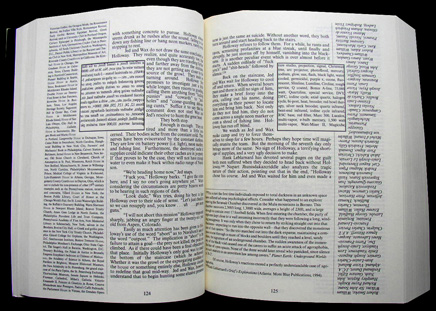
Another text that employs these navigational features as a part of its content is Mark Z. Danielewski’s House of Leaves.  The story is created through a series of fictional pasted together articles and has no fewer than 3 narrators (The original compiler, the one who found it, and the publishing editor).  The content of the book constantly refers back to its own fiction appendix or works which don't appear in the book that either can be found, and have little to do with the novel, or are completely fictionalized.  This makes that navigational element of the novel very apparent.  You do not read that book cover to cover; instead, it is read in parts as the reader is forced to navigate through the different narrators, subplots, and completely missing information.  In a work like this, not only do the graphic navigational devices make themselves clear to the reader, the entire basis of the narrative depends on how the reader navigates the work.  This renders the navigational and graphic elements visible, while also requiring an understanding of the use of the navigational/graphic to understand the narrative.


Sunday, November 6, 2011

Knock-knock. Who's there?


I’ll come out and admit that I wasn’t successful in getting Trip and Grace to work things out on any of my trips through Façade.  I originally saw that as the “goal” of the game, even though it’s never explicitly stated.  The lack of a clearly defined goal and method of reaching that goal were some of the things I really liked about playing Façade.  Instead of being tasked with saving this marriage, we’re simply dropped into this situation and set free.  I realized that trying to get the two to work things out, or understand the nature of their problems said much more about me as a player than it did about Façade itself.  I was surprised at how different each play through was, and how little the ‘inside information’ I picked up from earlier attempts.  After a few failed attempts at helping Trip and Grace stay together, I started to see what other options were available.  I tried deliberately taking a side and noticed that there were ways to put each character on the defensive.  Hugging/kissing Grace immediately after walking in, picking up the phone, and sitting with Grace when Trip wants to talk about his picture went a long way in changing the more assertive tone Trip had in early plays.  I got Grace to admit to painting the picture above the couch a few times. I also got thrown out of this apartment more often than any other result.  I must admit to having an unhealthy amount of fun reading through my stage plays and some of the stage plays on the InteractiveStory Forums as well as watching  YouTube videos after they popped up in the class Twitter feed.
I think Noah Wardrip-Fruin’s explanations of Façade made sense in terms of my reactions to/interactions with the game.  I thought about my frustrations with Emily Short’s Galatea hen he explained how interactivity worked in Façade.  Wardrip-Fruin notes that in Façade, “players are invited to perform more richly than in many digital fictions, which often limit interaction to the selection between a set of discrete choices (with everything else producing an error message)” (339).  I remember that when we talked about Galatea in class, asking a question or saying something that the game would recognize as a valid move were some of the hangups in moving the story forward. Galatea’s response “you cannot form your question into words” was a pretty frustrating way of saying “the question or statement you just made is not recognized by the programming as valid input,” especially considering that this game is text-based, and you were actually using words.  If you couldn’t ask/look at/say/think about something that would move the story forward, you were stuck. Wardrup-Fruin notices this shortcoming in interactive fiction, admitting that “no computer can actually ‘understand’ arbitrary human language—or even, less ambitiously consistently map human language statements to a logical model” (337).  If we’re going to use language as the main interface for interactive narrative, it’s important to recognize the fundamental difference between how human beings approach language as a medium for communication and how a given interactive piece (be it fiction, drama, etc.) recognizes language as input.
Façade manages to overcome these barriers.  Wardrip-Fruin explains that within Façade, “each beat has a default way it will play out in the absence of interaction, but Mateas and Stern are hoping for another outcome—given that the point of Façade is to pursue interactive drama” (335).  Even if I walked into the apartment, and do nothing more than sit on the couch, the drama between Trip and Grace would still play out.  Even though they allow the story to unfold without/with minimal user input, the makers of the game hoped for players to take the opportunity to participate in the storytelling.  The open-ended nature allows players to take these pieces of story and make it into just about anything.  I got thrown out of the apartment for trying to seduce Grace.  In one stage play, a player suggested a threesome.  Wardrip-Fruin notes that “there are also many transcripts featuring player characters somewhat closer to Façade’s expectations, but those that push the system are especially revealing” (339).  By taking the opportunity to explore alternatives to taking sides, playing the diplomat, or pretending to be a marriage counselor, the player can make an interesting/unexpected story using the tools provided by Mateas and Sterne. Wardrip-Fruin concedes that these other approaches to Façade “reveal something of the shape of the underlying system.  In this case, one sees the way Façade’s drama continues executing its beat goals, for the most part, even in the absence of intelligible player behavior” (339).  Instead of sticking players with the “I don’t understand your response” messages and freezing the narrative, Façade allows for creativity and freedom in the participatory narrative.